Leaf Blower for a Deck and Patio: What to Look For
For most decks and patios, a lightweight blower with adjustable speed is easier to control than a high-powered model. Match its airflow and power source to your surfaces, debris, and access to an outlet.
A good leaf blower for a deck or patio should clear dry leaves and grit without scattering them into the yard, garden beds, or a neighbor’s space. Look for manageable weight and variable speed first; choose a more powerful model only if you also need to clear larger areas or heavier debris.
What matters on a deck or patio
Variable speed or a low-speed setting: This makes it easier to move light debris without blasting it between deck boards or across the patio.
Airflow (CFM): Cubic feet per minute measures the volume of air the blower moves. More airflow can help move a larger pile, but it can also make fine debris harder to control.
Air speed (MPH): Miles per hour describes how fast the air exits the nozzle. High air speed can help loosen stuck leaves, but it is not a substitute for useful airflow or speed control.
Weight and balance: A lighter, well-balanced blower is more comfortable for quick cleanups, steps, and work near railings.
Noise: If you have close neighbors or use the blower early or late, check the manufacturer’s noise information and any local rules.
Don’t choose by the highest CFM or MPH alone. For a small area, control and comfort are often more useful than maximum output.
Choose a power source
Cordless battery blower
A cordless model is convenient for a small deck or patio because there is no cord to route around furniture, steps, or railings. Check the stated runtime and whether the battery is included. Runtime varies with the setting and battery, so use the manufacturer’s guidance to judge whether it will cover your cleanup.
If you already own compatible batteries from the same tool platform, a bare tool may be an option. Confirm battery compatibility rather than assuming batteries from the same brand all fit.
Corded electric blower
A corded model can make sense when you have a suitable outdoor outlet and want to avoid charging batteries. The cord can snag on furniture or limit your reach, and you’ll need to keep it clear of the nozzle and the area being cleaned. Use only an outdoor-rated extension cord if the manufacturer permits one, and follow the blower’s instructions for cord type and length.
Gas blower
For a deck or patio alone, a gas blower is usually more power and upkeep than necessary. Consider one only if it also serves larger, demanding cleanup jobs and you are comfortable with its maintenance, noise, and operating requirements.
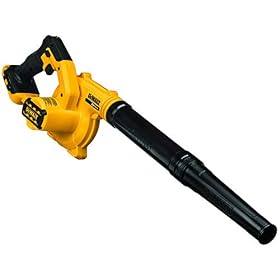
Lightweight cordless option for quick deck and patio cleanup
Product prices and availability are accurate as of the date/time indicated and are subject to change. Any price and availability information displayed on Amazon.com at the time of purchase will apply to the purchase of this product.
Match the blower to the surface and debris
Composite or wood decking: Start on a low setting and keep the nozzle moving. Avoid forcing debris into gaps or directing a strong stream at loose trim, finishes, or delicate surfaces.
Concrete or pavers: A moderate setting is usually enough for dry leaves and dust. Sweep debris toward a collection point instead of scattering it across the yard.
Wet or stuck leaves: These are harder to move than dry leaves. A small patio blower may not handle them well; let them dry or use a broom or rake rather than expecting more speed to solve the problem.
Corners and deck-board gaps: Use a narrower air stream carefully, or finish with a brush. Strong airflow can send debris somewhere harder to reach.
Before blowing, move lightweight items and check for gravel, mulch, or other debris that could become airborne. Direct the airflow away from people, pets, doors, and open windows, and wear eye protection as recommended by the manufacturer.
Product prices and availability are accurate as of the date/time indicated and are subject to change. Any price and availability information displayed on Amazon.com at the time of purchase will apply to the purchase of this product.
A simple buying decision
Choose a lightweight cordless blower with variable speed if you mainly clear a small deck or patio and want quick, untethered cleanup. Choose a corded model if an appropriate outdoor outlet is close by and you prefer not to manage battery runtime. If the area is large or you also clear a lawn and driveway, compare models for those bigger jobs—but make sure they still offer a controllable low setting for the deck.
If you already own a blower, try the lowest effective setting and sweep debris toward one collection area before buying another. A broom or brush may be the better tool for wet leaves, debris lodged in narrow gaps, or a very small patio.
FAQ
What kind of leaf blower is best for a small patio?
A lightweight blower with variable speed is usually easiest to control. A cordless model is convenient for quick cleanups; a corded model can work well if an appropriate outdoor outlet is nearby.
How much CFM do I need for a deck?
There is no single CFM number that fits every deck. For dry leaves and light debris on a small area, controllable airflow matters more than maximum CFM. Heavier debris or a larger cleanup may call for more airflow.
Can a leaf blower damage a deck?
Strong airflow can scatter grit, drive debris into gaps, or disturb loose finishes and trim. Start on a low setting, keep the nozzle moving, and follow the deck and blower manufacturers’ care instructions.
Will a small leaf blower move wet leaves?
Wet leaves are difficult to move and may be beyond a compact patio blower’s capability. Let them dry when practical, or use a broom or rake instead.